Food · Guide
How to Make Fresh Pasta From Scratch: Technique and Regional Italian Shapes
Published:
In brief
Fresh pasta is made by hand-kneading a dough of flour and eggs (north Italy) or durum wheat semolina and water (south Italy), resting it, then rolling and shaping it. The two traditions produce different textures and regional shapes, from Emilia-Romagna's tagliatelle and garganelli to Puglia's orecchiette.
Fresh pasta in Italy is not one recipe but two parallel traditions. In the north, cooks mix soft wheat flour with eggs to make a rich, tender dough; in the south, durum wheat semolina is mixed with water alone, producing a firmer, nuttier pasta, according to Eataly's regional guide to Italian pasta.
The two base doughs
Eataly's guide explains that northern Italy's soft wheat flour, labelled 'tipo 00', has lower protein content and needs eggs as a binder, which is why regions such as Emilia-Romagna, Piedmont and Lombardy are known for egg pasta. Durum wheat, grown mainly in central and southern Italy, has higher protein and does not need eggs, so southern pasta such as orecchiette is traditionally made only with semolina, water and salt.
According to the English Wikipedia entry on orecchiette, this is also true for most dried, factory-made pasta, which is produced industrially from durum wheat semolina and water without eggs.
Making egg pasta dough by hand
For egg pasta, Italian Recipe Book describes the classic 'well' method: flour is sifted into a mound on a wooden surface, a hollow is formed in the centre, and eggs are cracked into it. The eggs are beaten with a fork while flour is drawn in gradually from the inner edge of the well to avoid lumps, then the mixture is finished by hand and brought together with a bench scraper.
- Mound the flour and make a well in the centre; crack the eggs into the well.
- Beat the eggs with a fork, pulling in flour from the inner rim gradually.
- Once a dough starts to form, bring in the rest of the flour and knead by hand.
- Knead for about 10 minutes with slow, firm stretching and folding motions, turning the dough 90 degrees repeatedly, dusting with flour only if it sticks.
- Stop when the dough is smooth and only slightly tacky; a cross-section should show small air bubbles if kneading was sufficient.
- Wrap and rest the dough for at least 30 minutes at room temperature (up to 2 hours, or up to 8 hours refrigerated) before rolling.
Italian Recipe Book notes that a traditional rule of thumb for egg pasta is one egg per 100 grams of flour, but recommends a more precise method: weighing the eggs without their shells and multiplying that weight by 1.75 to calculate the matching amount of tipo 00 flour.
Shaping southern, water-based pasta: the orecchiette example
Southern shapes are formed without a rolling pin or machine. For orecchiette, the Wikipedia article states the dough is rolled into thin ropes, cut into small cubes, and each cube is pressed and dragged across the board with a small knife to curl it, then turned over the thumb to create its characteristic concave, 'little ear' shape. The same source traces documented use of orecchiette in the Apulia region, particularly around Bari, to at least the 12th or 13th century, while noting that food historians still debate whether the shape is of local Pugliese origin or arrived later from Provence under Angevin rule.
Shaping northern egg pasta: tagliatelle and garganelli
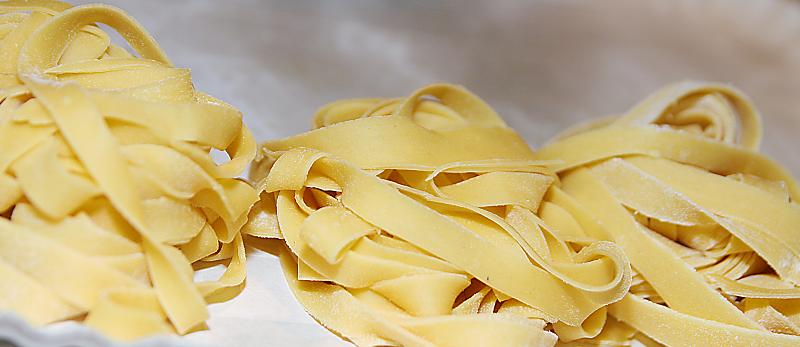
Once rested, egg dough is rolled thin and cut. Eataly's guide describes tagliatelle as a ribbon slightly wider than fettuccine, associated with the Emilia-Romagna and Marche regions.
Garganelli, also from Emilia-Romagna, are shaped individually: a small square of egg pasta is pressed onto a ridged wooden tool known as a pasta comb and rolled around a thin dowel, which leaves ridges on the outside of the resulting short tube, according to Chef's Mandala's account of the shape's history. The same source reports that the name comes from a dialect word for 'chicken gullet', describing the tube's resemblance to a bird's throat, and cites one unverified historical account placing the dish's creation in 1725 in the household of Cardinal Cornelio Bentivoglio d'Aragona, while noting the story's authenticity is not confirmed.
Regional shapes at a glance
| Shape | Region | Dough | Traditional shaping method |
|---|---|---|---|
| Tagliatelle | Emilia-Romagna | Egg + soft wheat flour | Rolled into sheets, cut into ribbons |
| Garganelli | Emilia-Romagna | Egg + soft wheat flour | Pressed and rolled on a ridged wooden comb |
| Tajarin | Piedmont | Egg (sometimes extra yolks) + soft wheat flour | Rolled very thin, cut into fine strands |
| Orecchiette | Puglia | Durum wheat semolina + water | Cut into cubes, dragged with a knife, curled over the thumb |
| Busiate | Sicily | Durum wheat semolina + water | Wound around a thin reed into a corkscrew |
The Reluctant Gourmet's regional survey confirms this north-south pattern across other shapes as well: Piedmont's tajarin is egg-based, while Sicily's busiate and Calabria's fileja are durum-wheat shapes wound by hand around a rod or reed, and Calabria's cavatelli are hand-shaped durum-wheat shells, rather than cut from a flat sheet.
Beat the eggs with a fork and start incorporating flour from the sides of the well into the egg mix, incorporating a little at a time to avoid the formation of lumps.
Practical notes for home cooks
- Egg pasta (tagliatelle, garganelli, tajarin) suits rich butter, cream or meat-based sauces that cling to a smooth, tender surface.
- Durum wheat pasta (orecchiette, busiate) has a rougher, firmer texture suited to holding chunky vegetable or seafood sauces.
- Resting the dough, whether egg-based or water-based, relaxes the gluten and makes rolling or shaping by hand easier.
- Specialised tools such as the garganelli comb or a reed for busiate can be approximated at home with everyday items such as a chopstick or a bamboo mat, according to Chef's Mandala.
Questions
- What is the basic ratio of flour to eggs for fresh pasta?
- Italian Recipe Book notes that a traditional rule of thumb is one egg per 100 grams of flour, though it recommends a more precise method: weighing the eggs without their shells and multiplying that weight by 1.75 to get the matching amount of tipo 00 flour.
- Why does southern Italian pasta not use eggs?
- Southern Italy's durum wheat semolina has higher protein content than the soft wheat flour used in the north, so it does not need eggs as a binder; it is traditionally mixed with water and salt instead, per Eataly's regional guide.
- How long should fresh pasta dough rest before rolling?
- Italian Recipe Book recommends resting the kneaded dough for at least 30 minutes at room temperature, up to 2 hours at room temperature or up to 8 hours in the refrigerator, before rolling it out.
- How is orecchiette traditionally shaped without machines?
- According to Wikipedia, the dough is rolled into thin ropes, cut into cubes, and each cube is dragged across the board with a small knife to curl it, then flipped over the thumb to form its concave, ear-like shape.
- What gives garganelli its ridged surface?
- A square of egg pasta is pressed onto a ridged wooden tool called a pasta comb and rolled around a thin dowel, which imprints ridges on the outside of the tube, as described by Chef's Mandala.
Sources
This piece was prepared with artificial intelligence and passed an automated source check before publication. If you see an error, ask for a correction. Request a correction or reply · How we make this
Related
FoodArticle
How Sterile-Pack Technology Turned Instant Rice Into a Global Staple
Instant rice reaches store shelves through aseptic processing: rice is milled, cooked and sealed inside its own tray using high-pressure steam, giving it a nine-month shelf life without preservatives. The method, commercialized in South Korea in 1996, now underpins a global market projected to grow from about $4.98 billion in 2026 to $7.73 billion by 2034, as Korean makers expand exports to roughly 60 countries.
FoodGuide
How to Ferment Vegetables at Home: A Beginner's Safety Guide
Fermenting vegetables at home relies on salt, an airtight anaerobic environment and full submersion in brine to let naturally occurring lactic acid bacteria turn sugars into acid. Following tested salt ratios (roughly 2–3% for shredded vegetables, about 5% for whole pieces), keeping temperatures between roughly 68–72°F (20–22°C), and watching for slime or rotten odors as signs to discard are the core safety rules from university extension services.
FoodArticle
Turkey's Olive Harvest: Changing Techniques, Who Does the Work, and Why It Matters
Turkey's olive harvest opens every October, starting with table olives on irrigated lowlands before moving to oil-variety trees once seasonal rain arrives. In Aydın province, the country's largest olive-growing area, hand-combing has largely replaced stick-beating, a shift that has put more women than men in the orchards, earning roughly 1,000 Turkish lira a day.

FoodGuide
How to Make Fresh Pasta at Home: Egg Dough, Rolling and Classic Shapes
Fresh pasta is made by mixing flour and eggs (or semolina and water for egg-free styles) in roughly a 100g-flour-to-1-egg ratio, kneading until smooth, resting the dough, then rolling it thin and cutting it into shapes. The two main families are egg pasta made with "00" flour, common in central and northern Italy, and egg-free semolina pasta made with durum wheat and water, typical of southern Italy.