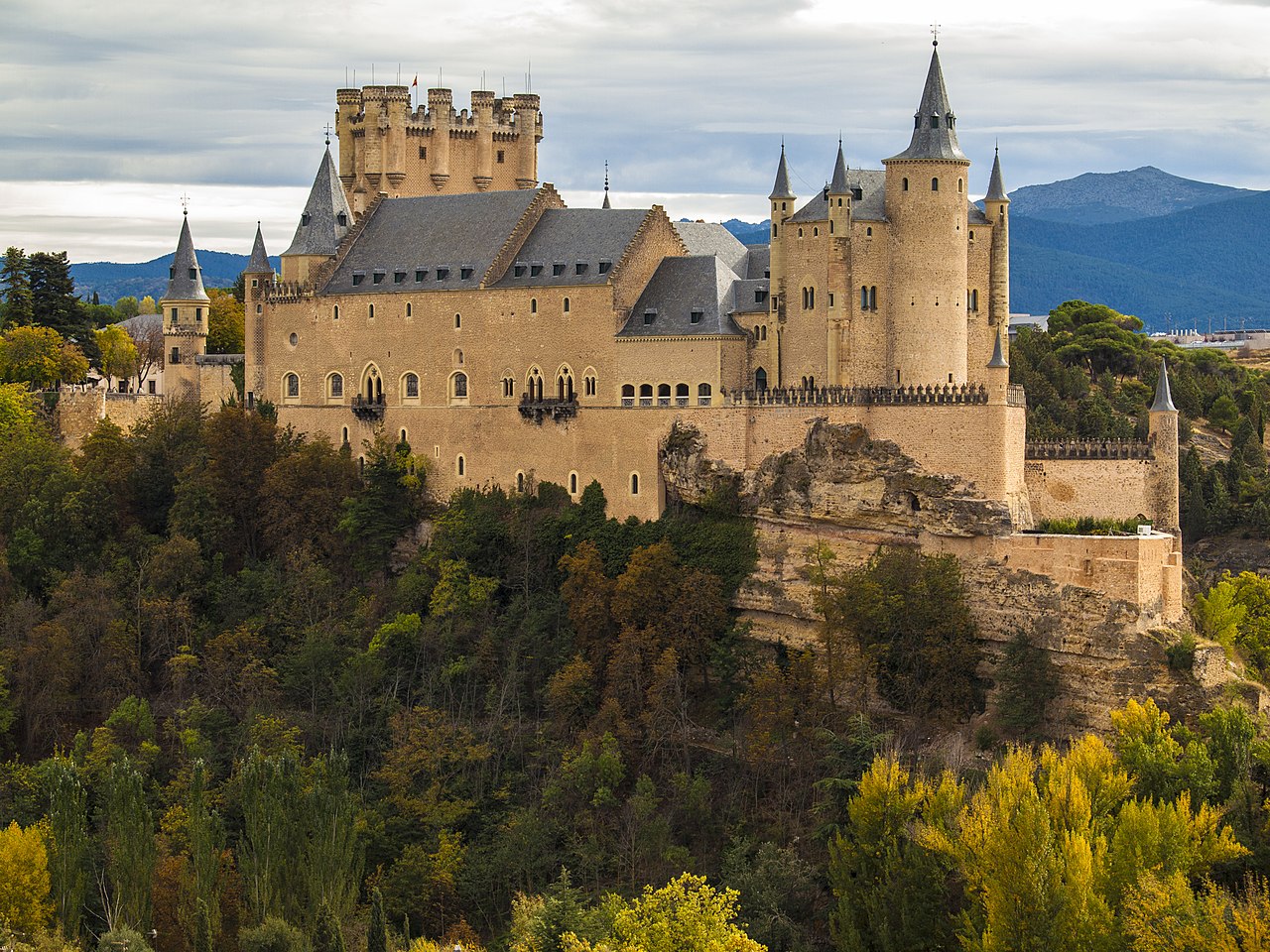
Medieval castles were fortified residences that combined military defense, lordly housing and local administration, emerging after the Carolingian Empire's collapse in the 9th-10th centuries and spreading rapidly after the Norman Conquest of 1066. Their design evolved from earth-and-timber motte-and-bailey structures to stone keeps and multi-walled concentric fortresses before gunpowder artillery made them militarily obsolete by the 16th century.
From Earth and Timber to Stone
According to the English-language Wikipedia entry on castles, these private fortified residences first appeared in the 9th and 10th centuries, after the collapse of the Carolingian Empire left individual lords responsible for their own defense and local governance. Early builders relied on earthen mounds and timber palisades because these materials allowed defenses to be raised quickly.
In England, castle-building accelerated sharply after the Norman Conquest of 1066, according to English Heritage. The chronicler Orderic Vitalis, writing in the early 12th century, noted that fortifications of this kind had been largely unknown in the English provinces before the conquest, which English Heritage says helps explain why English resistance to the Normans proved ineffective. English Heritage states that William the Conqueror and his followers built roughly 1,000 castles across England and Wales over the following 150 years.
Castle Types and Core Features
The earliest Norman castles were ringworks and motte-and-bailey designs: an artificial mound (the motte) topped by a wooden tower, next to a fenced courtyard (the bailey), per English Heritage. From the 12th century, stone began replacing timber, and by the late 12th-13th centuries castles were built with polygonal shapes and towers positioned to allow flanking fire, according to Wikipedia's overview of the castle as a building type.
Keep (donjon): the central tower, used as last line of defense and sometimes as noble residence
Curtain walls: perimeter walls studded with towers
Gatehouse, drawbridge and portcullis: controlled, defensible entry points
Moat: a water- or earth-filled ditch slowing attackers
Arrow slits and battlements: allowed defenders to shoot while staying protected
English Heritage notes that under Henry I and Henry II, England saw major investment in stone keeps at Dover, Scarborough and Orford, with walls up to six metres thick — far more resistant to attack than timber. Later, defensive emphasis shifted outward to gatehouses and projecting towers, and concentric castles — with two full rings of walls, the outer lower than the inner — represented the most advanced design; Dover Castle is cited by English Heritage as an example of this approach.
Main medieval castle types in England
Type
Period
Materials
Example
Motte-and-bailey
11th-12th century
Earth mound, timber tower and palisade
Early post-1066 Norman castles (English Heritage)
Stone keep
12th century
Stone tower, walls up to 6 m thick
Dover, Scarborough, Orford (English Heritage)
Concentric
12th-13th century
Double stone curtain walls
Dover Castle (English Heritage)
Late medieval residence
14th-15th century
Stone with larger courtyards, comfortable quarters
Bodiam, Warkworth (English Heritage)
More Than a Fortress: Administration and Social Life
Castles were not purely military. HistoryCooperative.org describes them as serving simultaneously as defensive structures, noble residences and administrative centers where taxes were collected, justice dispensed and local trade controlled. Ground floors typically held storerooms, kitchens and a great hall, while upper floors contained the noble family's private chambers.
Socially, castles reinforced the feudal hierarchy and hosted ceremonial gatherings and feasts; many included a chapel as a spiritual center, according to the same source. Their scale and visible defenses also functioned as a display of a lord's authority over the surrounding territory.
Edward I's Castles in Wales: A UNESCO World Heritage Site
One of the clearest illustrations of castle architecture's cultural weight is the UNESCO World Heritage Site "Castles and Town Walls of King Edward in Gwynedd," inscribed in 1986, according to the UK National Commission for UNESCO. The listing covers the castles of Beaumaris, Caernarfon, Conwy and Harlech in north Wales; at Caernarfon and Conwy, new towns were built within the massive castle walls.
The UK National Commission for UNESCO states that King Edward I of England ordered the castles built following his 1276 campaign against the Welsh prince Llywelyn ap Gruffudd, with all four castles begun and substantially completed between 1283 and 1330. They were designed by James of St George, described by the Commission as Edward I's chief architect and the most accomplished military architect of his era.
The finest surviving example of late thirteenth-century military architecture in Europe.
— UK National Commission for UNESCO, on the Gwynedd castles
Decline of the Fortified Castle
By the 14th-15th centuries, English castles such as Bodiam and Warkworth were being built as more comfortable residences with larger courtyards, English Heritage notes, reflecting a gradual shift away from pure defense. Wikipedia's overview states that 15th-century gunpowder artillery made traditional castle defenses militarily obsolete, and by the 16th century new construction had largely given way to star-shaped artillery forts.
In England specifically, English Heritage attributes the end of large-scale baronial castle-building to Tudor-era centralization of power, combined with Henry VIII's construction of coastal artillery forts — England's first coordinated national coastal defense system since Roman times. From the 17th century onward, according to Wikipedia, new "castles" were increasingly built as romantic architectural statements rather than functioning fortifications.
Questions
What is a motte-and-bailey castle?
It is an early medieval fortification combining an artificial mound (motte) topped with a wooden tower and an adjoining enclosed courtyard (bailey), used widely by the Normans from the 11th century, according to English Heritage.
Why were medieval castles built?
They served as defensive strongholds, noble residences, and administrative centers for tax collection and justice, while also displaying a lord's authority, according to HistoryCooperative.org.
When did castles stop being militarily useful?
Wikipedia's overview states that 15th-century gunpowder artillery made traditional castle defenses obsolete, with star-shaped artillery forts replacing them by the 16th century.
Which medieval castles are UNESCO World Heritage sites?
Beaumaris, Caernarfon, Conwy and Harlech castles in Gwynedd, Wales, built for Edward I between 1283 and 1330, were inscribed as a UNESCO World Heritage Site in 1986, per the UK National Commission for UNESCO.
Who designed Edward I's Welsh castles?
The UK National Commission for UNESCO states they were designed by James of St George, described as Edward I's chief architect.
This piece was prepared with artificial intelligence and passed an automated source check before publication. If you see an error, ask for a correction. Request a correction or reply · How we make this
Long before European colonization, the African continent was home to powerful states that built pyramids, ran trans-Saharan gold-and-salt economies, and raised cities of carved stone. This list ranks seven ancient African kingdoms by the scale of their political, economic or architectural reach, based on dates and figures from historians, UNESCO and museum records.
The internet began as a U.S. defense research network called ARPANET in 1969 and became the World Wide Web two decades later through a 1989 proposal at CERN. Today roughly 6 billion people — about three-quarters of the world's population — use the internet, according to the UN's International Telecommunication Union (ITU).
Archaeologists use two broad approaches: relative dating, which orders finds by layer or style without giving a year, and absolute (scientific) dating, which uses physical or chemical changes — such as carbon-14 decay, tree-ring patterns or potassium-argon decay — to estimate a calendar-based age range. Most sites are dated by combining several of these methods rather than relying on one alone.
Ancient Rome ran its affairs through elected magistrates, a senate of former officials and popular assemblies for roughly five centuries before power concentrated in a single emperor from 27 BCE. Its rigid social hierarchy, its legal code and its Latin tongue went on to shape European and wider Western institutions long after the empire itself fell.